A political committee
Preserve the promise.
Rebuild the trust.
We defend the 14th Amendment, and finish what the Freedman's Bank started: a promise made to the Freedmen of this country, and never kept.
A political committee
We defend the 14th Amendment, and finish what the Freedman's Bank started: a promise made to the Freedmen of this country, and never kept.
Techno-Foundationalism is the strategic independent doctrine of enforcing 14th Amendment constitutional protections through direct capital, infrastructure, and computational ownership.
The legal and technological foundation of the modern American republic and the Foundational American Economy rests on the 14th Amendment and the Freedmen's Bureau Acts—statutes explicitly enacted to guarantee full economic, legal, and political citizenship to Foundational Black American Freedmen, the lineage behind today's Technocratic Foundational movement.
Civil rights without physical infrastructure ownership offer zero defense against systemic economic exclusion.
In the 21st-century economy, equal protection under the law requires equal access to and control over the productive engines of our time: energy grids, data infrastructure, capital markets, and advanced compute capacity.
A Technocratic Foundational is an investor, policy strategist, builder, engineer, or civilizational architect utilizing this constitutional baseline to secure high-yield, sovereign infrastructure assets for the lineage. As a Super PAC, the Vanguard of the 14th exists to deploy targeted capital, enforce legislative compliance, and back candidates who champion this mandate.
14th Amendment equal protection and statutory Freedmen's lineage guarantees.
Independent expenditures, targeted campaign leverage, and un-throttleable political capital velocity.
Compute sovereignty, energy grid integration, and direct capital ownership for Technocratic Foundational Black Americans.
1865 – 1874
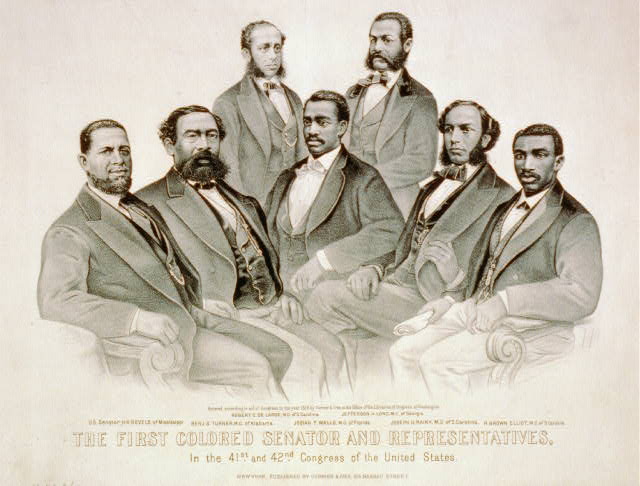
Congress chartered the Freedman's Savings and Trust Company so the formerly enslaved could build wealth in safety. Within nine years, the bank's own trustees had quietly loaned depositors' savings to their friends and business partners.
When the panic of 1873 hit, there was nothing left to stand on. Frederick Douglass took over as president in a last attempt to save it. He was six weeks too late.
The record
14th Amendment, Section 1
“All persons born or naturalized in the United States… are citizens of the United States… nor shall any State deprive any person of life, liberty, or property, without due process of law; nor deny to any person within its jurisdiction the equal protection of the laws.”
Justice Clarence Thomas called "freedman" a "decidedly underinclusive proxy for race" - the Freedmen's Bureau Acts covered freedmen specifically, not Black Americans broadly. Section 1 protects all persons; the debt from the Freedman's Bank is owed to the Freedmen it was built for.
Section 5 — Congress may enforce this by legislationThe charter
The Freedman's Bank failed in the dark, moved by trustees no one outside the room could see. Every institution we back is built for the Freedmen the first one was built for, so that failure mode cannot repeat.
A public, immutable record. Every loan, transfer, and reserve position, auditable as it happens — by regulators, depositors, and the public.
Underwriting and fraud models are tested for discriminatory impact before they touch a single application, expanding credit for the descendants the original bank was chartered to serve. Equal protection applies to algorithms too.
Security standards built to hold for the next fifty years of deposits, not the next five.
We are a political committee. We hold no deposits, offer no accounts, and sell no financial product. No fund tied to the historical Freedman's Bank exists for depositors' descendants to claim — and no "quantum financial system" offering guaranteed returns is real. Report either claim to the FTC.
Transcontinental Techno-Advocacy
Techno-Capital, Asymmetric Leverage, and Global Markets
To catalyze permanent Freedmen macroeconomic sovereignty, Vanguards of the 14th (V14) bypasses legacy multilateral aid models by advocating for a bilateral, enterprise-driven trade architecture. V14 is not a model. V14 is a techno-political committee with Civilizational Redesign, Neural Architecture & Innovation Diplomacy Abroad built into its core mandate. Fully aligned with current federal commercial diplomacy doctrines centered on transactional bilateral frameworks over bureaucratic foreign assistance, this framework advocates for sovereign economic conduits between advanced technology nodes in global markets and domestic Freedmen AI infrastructure (Freedom Cities). Rather than competing in legacy physical construction, V14 advocates an asymmetric cognitive framework designed to anchor Generational Yield Entanglement inside U.S. Freedom Cities.
Trying to outspend competitor state actors on physical concrete and steel in emerging markets is a legacy trap. They own the balance sheets for physical logistics; we must own the cognitive architecture, data centers, quantum AI, and sovereign compute power required to secure autonomous technological sovereignty for Foundational Black American Freedmen.
Learn MoreWe are moving far beyond ordinary commerce into a complete systemic upgrade of how human networks organize, govern, and scale.
Learn MoreNo legacy Silicon Valley Super PAC possesses the structural DNA of the 14th Amendment. V14 wields this constitutional mandate to operationalize a global framework uniting Freedmen technology patents, compute sovereignty, and the historical lineage of the Brown Condor into a transcontinental bridge of trust.
Learn MoreCapitalized by a sovereign network of Industry 5.0 venture architects, engineers, and strategic operators converting unliquidated constitutional equity into the U.S. Quantum Grid.